Article Lying to Make America White Again

Pro-Trump extremists breached the U.S. Capitol on Wednesday. The coup was just the latest chapter in America's ongoing battle over race, writes NPR host Sam Sanders. Victor J. Blueish/Bloomberg via Getty Images hide explanation
toggle caption
Victor J. Bluish/Bloomberg via Getty Images
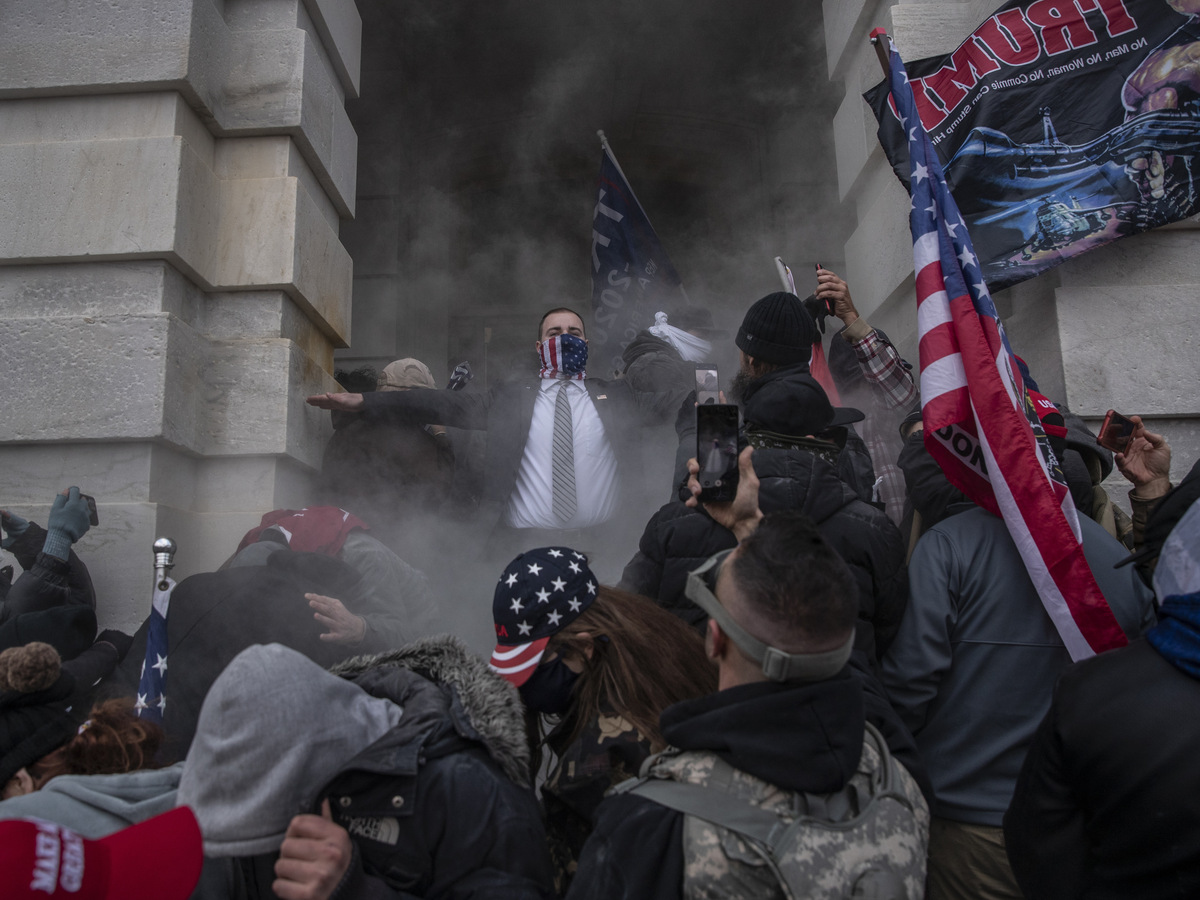
Pro-Trump extremists breached the U.Southward. Capitol on Wednesday. The insurrection was just the latest chapter in America'due south ongoing battle over race, writes NPR host Sam Sanders.
Victor J. Blueish/Bloomberg via Getty Images
There is a lie some Americans tell themselves when America is on its worst behavior: "This isn't America!" or "This isn't who we are!" or "We're meliorate than this!"
You heard versions of this lie again this past calendar week later armed insurrectionists stormed the U.S. Capitol on urging from President Trump, attempting to undo the results of terminal November's election.
Even in the halls of Congress, after the cleaved glass was cleared and U.S. senators and representatives were allowed back into their chambers from undisclosed locations, Republican Sen. Ben Sasse of Nebraska came dorsum to this refrain: "Our kids need to know that this isn't what America is."
We are a country built on fabrication, nostalgia and euphemism. And every time America shows the worst of itself, all the contradictions collapse into the lie I've heard nonstop for the concluding several years: "This isn't who we are."
In the last weeks of Donald Trump'south presidency, we are still collectively struggling over whether to treat his term and the reaction to it every bit an aberration or every bit a continuation of an American fashion of life. Then much of information technology feels unprecedented: the emergence of the Trump-led Twitter news cycle, the abandonment of political norms nosotros thought were etched in rock, the seemingly never-ending protestation movements sprouting up in reaction to information technology all.
It all feels new. Only it is not.
The images from the Capitol this past calendar week made that clear: a noose hanging outside the building. Inside, insurrectionists carrying a Confederate flag. Members of the mob wearing T-shirts that read "Civil War."
Our electric current troubles — and our electric current administration — are both but the latest chapters in America's ongoing battle over race.
In one case you encounter it equally such, information technology all makes a lot more sense. Remember, Trump began his ascent to political power on a racist lie: birtherism. He launched his campaign for the presidency calling Mexican immigrants criminals and rapists. His first major policy initiative was travel restrictions on Muslim-bulk nations that felt a lot like a travel ban on people with darker skin. His supporters cited "economic anxiety" as their motivation, just they were driven by racial animus. Former KKK leader David Knuckles endorsed Trump twice for president.
Trump's presidency has always been well-nigh race and reacting to a nation more various than it has ever been. We've been reminded of that time and again since he announced his candidacy. So how tin anyone still say, "This is non who we are"? Why exercise we go along to hear that same lie as the worst of America rears its caput?
I run across glimpses of who we are every day and, at the same time, a deep discomfort with that reality. That lie permeates my industry, the media. There would have been a time, several years ago, where if I had attempted to write this essay using words like "racist" or "lie," I would have been told to rewrite it. Urged to soften the tone. To maybe not brand it all about race. This is not an indictment of NPR; the entire manufacture did it. Much of the industry even so does.
Fifty-fifty this by week, in that location was mitt-wringing about what to call the rioters storming the U.S. Capitol and how to describe their insurrection.
But I'd be wrong to say information technology's simply the media that nurtures the prevarication. Our audiences do as well.
As a Black NPR host, I am often talking to mostly white audiences about race. Past and large, listeners are happy to go where those conversations lead, but regularly, a loud minority shows that information technology really wants no part of such discussions. Listeners send emails wondering whether I e'er talk about annihilation but race. Others suggest I may actually have information technology all wrong, invoking some version of "not all white people."
A contempo instance came after an interview with an Asian American writer, tracing the long history of discrimination against Asians in this state. Several white listeners wondered why other groups just didn't "piece of work hard" the manner their own white ancestors did. And and then another listener wrote they didn't consider themselves "the least chip racist," but chosen all Asians "manipulative and dishonest."
The lie is all around us. So when weeks like the i we just experienced happen, some yell the lie even louder, to our detriment. What would happen if we decided to exist more honest about race the next time our nation plant itself at a racial flashpoint? What might be lost? What might be gained?
It'due south hard to know, because I've never seen u.s., collectively, do information technology before. Simply I know that history only yells louder each time we refuse to heed. And no lie, no matter how often it's told, can proceed the truth at bay.
Sam Sanders is a contributor and host of the NPR podcast Information technology's Been a Minute With Sam Sanders. The show's latest episode, "The Capitol, Mobbed," is available for streaming here .
Source: https://www.npr.org/2021/01/10/955392813/the-lies-we-tell-ourselves-about-race
0 Response to "Article Lying to Make America White Again"
Post a Comment