The Term Market Potential or Industry Potential Refers to What Important Marketing Factor?
A target market is a group of customers inside a concern'southward serviceable available market at which a business aims its marketing efforts and resources. A target marketplace is a subset of the total market for a product or service.
The target market typically consists of consumers who exhibit similar characteristics (such every bit age, location, income or lifestyle) and are considered most likely to purchase a business's market place offerings or are likely to be the almost profitable segments for the business to service.
One time the target market(southward) have been identified, the business volition normally tailor the marketing mix (4 Ps) with the needs and expectations of the target in mind. This may involve conveying out additional consumer research in guild to gain deep insights into the typical consumer's motivations, purchasing habits and media usage patterns.
The pick of a suitable target market is 1 of the last steps in the market segmentation process. The choice of a target market relies heavily on the marketer's judgement, afterwards carrying out bones enquiry to identify those segments with the greatest potential for the business.
Occasionally a business may select more than ane segment every bit the focus of its activities, in which case, it would normally identify a master target and a secondary target. Primary target markets are those market segments to which marketing efforts are primarily directed and where more of the business's resources are allocated, while secondary markets are often smaller segments or less vital to a production's success.
Selecting the "right" target marketplace is a complex and hard decision. However, a number of heuristics have been developed to assist with making this decision.
Definition [edit]
A target market is a group of customers (individuals, households or organisations), for which an system designs, implements and maintains a marketing mix suitable for the needs and preferences of that grouping.[one]
Target marketing goes against the grain of mass marketing. It involves identifying and selecting specific segments for special attending.[ii] Targeting, or the selection of a target market, is just one of the many decisions made past marketers and business analysts during the segmentation procedure.
Examples of target markets used in practice include:[3]
- Rolls-Royce (motor vehicles): wealthy individuals who are looking for the ultimate in prestige and luxury.
- Dooney and Bourke handbags: teenage girls and young women under 35 years
Background [edit]
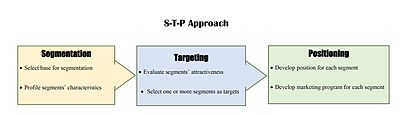
Selecting the target marketplace is the second pace in the STP approach
Selection of a target market (or target markets) is office of the overall procedure known as S-T-P (Southegmentation→Targeting→Positioning). Before a business concern can develop a positioning strategy, information technology must first segment the market and identify the target (or targets) for the positioning strategy. This allows the business to tailor its marketing activities with the needs, wants, aspirations and expectations of target customers in mind.[4] This enables the business to use its marketing resources more efficiently, resulting in more cost and time efficient marketing efforts. It allows for a richer agreement of customers and therefore enables the creation of marketing strategies and tactics, such every bit production design, pricing and promotion, that will connect with customers' hearts and minds. Also, targeting makes it possible to collect more precise information virtually customer needs and behaviors and then analyze that information over time in order to refine market strategies finer.[5]
The first pace in the S-T-P process is market segmentation. In this stage of the planning process, the business organization identifies the market potential or the total available market (TAM). This is the total number of existing customers plus potential customers, and may also include of import influencers. For example, the potential market or TAM for feminine germ-free products might be defined equally all women aged xiv–l years. Given that this is a very broad market in terms of both its demographic composition and its needs, this market can be segmented to define whether internal groups with unlike product needs can be identified. In other words, the market is looking for marketplace-based opportunities that are a proficient lucifer its current product offerings or whether new product/service offerings need to be devised for specific segments within the overall market.

Market segmentation [edit]
Markets generally fall into two broad types, namely consumer markets and business markets . A consumer market consists of individuals or households who buy goods for private consumption and do not intend to resell those goods for a turn a profit. A business market place consists of individuals or organisations who purchase goods for one of iii master purposes; (a) for resale; (b) for use in producing other goods or services and; (c) for general utilize in daily business operations.[half dozen] Approaches to segmentation will vary depending on whether the total available market (TAM) is a consumer marketplace or a concern market.
Market segmentation is the process of dividing a total available market, using one of a number of primal bases for segmenting such as demographic, geographic, psychographic, behavioural or needs-based segments. For example, a demographic segmentation of the developed male person population might yield the segments, Men 18-24; Men 25-39, Men forty-59 and Men 60+. Whereas a psychographic segmentation might yield segments such as Young Singles, Traditional Families, Socially Awares and Conservatives. Identifying consumer demand and opportunity within these segments should help the marketer to identify the most profitable segments.
Although in that location are many different ways to segment a marketplace, the almost common bases used in practise are:[7]
- Geographic – Residential address, location, climate, region.
- Demographic/socioeconomic segmentation – Gender, historic period, income, occupation, socio-economic status, educational-level, family status, marital condition, indigenous group, religious affiliation.
- Psychographic – Attitudes, values, beliefs, interests and lifestyles.
- Behavioral – usage occasion, degree of loyalty, user condition, purchase-readiness[eight]
- Needs-based segmentation – relationship between the customer's needs for specific features and product or service benefits[9]
During the market sectionalization process, the marketing analyst will have developed detailed profiles for each segment formed. This profile typically describes the similarities between consumers within each segment and the differences between consumers beyond each of the segments. The primary use of the segment profile is to assess the extent to which a house's offerings meet the needs of different segments. A contour will include all such information as is relevant for the production or service and may include basic demographic descriptors, purchasing habits, disposition to spend, benefits-sought, brand preferences, loyalty behavior, usage frequency and any other information deemed relevant to the subject at paw.[10]
The segment profile assists in the decision-making process and has a number of specific benefits:[10]
- assists to determine those segments that are near bonny to the business
- provides quantitative information nigh segments for a more objective cess of segment attractiveness
- assists in tailoring the product or service offering to the needs of diverse segments
- provides bones data to assist with targeting
- allocating the firm'southward resources effectively
Subsequently profiling all the marketplace segments formed during the division procedure, detailed marketplace assay is carried out to identify i or more segments that are worthy of further investigation. Additional research may be undertaken at this juncture to ascertain which segments require detailed analysis with the potential to become target segments.
Selecting the target marketplace [edit]
A primal consideration in selecting the target markets is whether customer needs are sufficiently dissimilar to warrant partition and targeting. In the event that customer needs across the unabridged market are relatively similar, and then the business may decide to use an undifferentiated approach. On the other hand, when customer needs are dissimilar across segments, then a differentiated (i.east. targeted) approach is warranted. In certain circumstances, the segmentation analysis may reveal that none of the segments offer 18-carat opportunities and the firm may decide not to enter the market.[11]
When a marketer enters more than one marketplace, the segments are frequently labeled the primary target market and the secondary target market. The primary market is the target market selected as the main focus of marketing activities and most of the firm'south resources are allocated to the primary target. The secondary target market is likely to be a segment that is non as large every bit the chief market place, but may have growth potential. Alternatively, the secondary target grouping might consist of a small-scale number of purchasers that account for a relatively high proportion of sales volume perhaps due to buy value, purchase frequency or loyalty.[12]
In terms of evaluating markets, 3 core considerations are essential:[13]
- Segment size and growth
- Segment structural attractiveness
- Compatibility with company objectives and resources.
However, these considerations are somewhat subjective and call for high levels of managerial judgement. Appropriately, analysts accept turned to more objective measures of segment bewitchery. Historically a number of different approaches have been used to select target markets. These include:[14]
- Distance Benchmark: Nether this arroyo, the business attempts to define the master geographic catchment area for the business by identifying people who live within a predetermined distance of the business. For a retailer or service-provider the distance might be around v km; for domestic tourist destination, the distance might be 300km. This method is used extensively in retailing.
- Sales Benchmark: Using this method, the business concern allocates its resources to target markets based on historical sales patterns. This method is peculiarly useful when used in conjunction with sales conversion rates. This method is used in retail. A disadvantage of the method is that it assumes past sales will remain abiding and fails to account for incremental market place potential.
- Interest Survey Methods: This method is used to place new concern potential. Master research, typically in the form of surveys, identifies people who accept not purchased a product or service, but take positive attitudes and exhibit some involvement in making a purchase in the short-term. Although this method overcomes some of the disadvantages of other methods, it is expensive fifty-fifty when syndicated research is used.
- Chain ratio and indexing methods: This method is used in marketing of branded goods and retail. It involves ranking culling market segments based on current indices. Widely used indices are the Category Index and Brand Alphabetize. The Category Index measures overall patterns within the product category while the Brand Index calculates a given make's performance within the category. Past dividing the Category Index by the Brand Index, a measure of market place potential can be obtained.
International segmentation and targeting [edit]
Segmentation and targeting for international markets is a disquisitional success factor in international expansion. Yet, the diversity of strange markets in terms of their market attractiveness and risk profile, complicates the process of selecting which markets to enter and which consumers to target. Targeting decisions in international markets have an additional layer of complication.
An established stream of literature focussing on International Market Segmentation (IMS) suggests that international segmentation and targeting decisions utilize a two-phase process:[15]
- 1. Macro-segmentation (assess countries for market attractiveness, i.due east. market size, market place potential)
- 2. Micro-segmentation (i.e. consumer-level based on personal values and social values)
Analysis carried out in the beginning phase focuses involves the collection of comparative information nigh dissimilar countries with a view to identifying the most valuable markets to enter. This is facilitated past the relatively wide data availability for macro-variables. Nearly government departments collect business demography data too as data for a wide range of economic and social indicators that can be used to gauge the attractiveness of various destinations.
Positioning [edit]
Positioning is the final stride in the S-T-P planning approach (Segmentation→ Targeting → Positioning).[16] Positioning refers to decisions nigh how to present the offer in a manner that resonates with the target market. During the research and assay carried out during the segmentation and targeting procedure, the marketer volition have gained insights into what motivates consumers to purchase a product or brand. These insights can exist used to inform the development of the positioning strategy.
Firms typically develop a detailed positioning statement which includes the target market place definition, the market place need, the production name and category, the key benefit delivered and the basis of the product's differentiation from any competing alternatives. The communications strategy is the chief ways by which businesses communicate their positioning statement to target audiences.[17]
Marketing mix (4 Ps) [edit]
In one case the segmentation has been carried out, target markets selected and the positioning strategy developed, the marketer can begin to shape the marketing mix (or marketing programme) around the needs, wants and motivations of the target audience.[18] The traditional marketing mix refers to iv wide levels of marketing conclusion, namely: product, price, promotion, and place.[xix] When implemented successfully, these activities should evangelize a firm's products or services to target consumers in a cost efficient manner. The 4 core marketing activities include: production, cost, identify and promotion.[xx]
The marketing mix is the combination of all of the factors at the control of a marketing director to satisfy the target market.[21] The elements of the marketing mix are: Product – the item or service that is being offered, through its features and consumer benefits and how it is positioned within the marketplace whether it exist a loftier or depression quality production. Price, is a reference to the sacrifices made by a consumer to acquire a production and may include both budgetary and psychological costs such equally the combination of the ticket price, payment methods and other associated acquisition costs. Identify refers to the way that a product physically reaches the consumer – where the service or item is sold; it likewise includes the distribution channels in which the company uses to get products or services to market place. Finally, Promotion refers to marketing communications used to convey the offer to consumers and may include; personal selling, advertising, public and customer relations, sales promotion and whatever other activities to communicate with target markets.[22]
The get-go reference to the term, the 'marketing mix' was claimed to exist in around 1950 by Neil H. Borden.[23] [24] Borden first used the term, 'marketing mix' in an address given while he was the President of the American Marketing Clan in the early on 1950s. For instance, he is known to accept used the term 'marketing mix' in his presidential address given to the American Marketing Association in 1953.[25] All the same, at that stage, theorists and academics were not in understanding every bit to what elements made upward the so-called marketing mix. Instead, they relied on checklists or lengthy classifications of factors that needed to exist considered to sympathise consumer responses.[26] It wasn't until 1960 when E. Jerome McCarthy published his at present-classic work, Basic Marketing: A Managerial Arroyo that the subject accepted the 4 Ps equally constituting the core elements of the marketing mix.[27] In the 1980s, the 4 Ps was modified and expanded for use in the marketing of services, which were believed to possess unique characteristics which necessitated a different marketing plan. The unremarkably accepted 7Ps of services marketing include: the original iv Ps of product, price, place, promotion plus participants (people), physical evidence and process.[28]
Product [edit]
A 'Product' is "something or anything that tin be offered to the customers for attending, conquering, or consumption and satisfies some want or need." (Riaz & Tanveer (n.d); Goi (2011) and Muala & Qurneh (2012)). The product is the main means of demonstrating how a visitor differentiates itself from competitive market offerings. The differences tin can include quality, reputation, product benefits, production features, brand name or packaging.
Toll [edit]
Price provides customers with an objective measure of value.(Virvilaite et al., 2009; Nakhleh, 2012). Price can be an important signal of product quality. Prices can besides attract specific market segments. For instance, premium pricing is used when a more affluent segment is the target, but a lower-priced strategy might be used when price-conscious consumers are the target. Toll can also be used tactically, as a means to advertise, short stints of lower prices increase sales for a variety of reasons such as to shift product over-runs or out of flavour goods.
Place [edit]
Identify refers to the availability of the production to the targeted customers (Riaz & Tanveer, n.d). And then a product or company doesn't have to be close to where its customer base is but instead they merely have to make their product as available as possible. For maximum efficiency, distribution channels must place where the target marketplace are almost likely to make purchases or access the production. Distribution (or place) may also need to consider the needs of special-involvement segments such as the elderly or those who are confined to wheelchairs. For instance, businesses may need to provide ramps for wheelchair access or baby change rooms for mothers.
Promotion [edit]
Promotion refers to "the marketing advice used to brand the offer known to potential customers and persuade them to investigate it further".[29] May comprise elements such every bit: advertising, PR, direct marketing and sales promotion. Target marketing allows the marketer or sales team to customize their message to the targeted group of consumers in a focused way. Enquiry has shown that racial similarity, office congruence, labeling intensity of ethnic identification, shared knowledge and indigenous salience all promote positive effects on the target market. Research has generally shown that target marketing strategies are constructed from consumer inferences of similarities between some aspects of the advertising (e.m., source pictured, linguistic communication used, lifestyle represented) and characteristics of the consumer (e.grand. reality or desire of having the represented manner). Consumers are persuaded by the characteristics in the advertisement and those of the consumer.[thirty]
Strategies for segmenting and targeting [edit]
Marketers have outlined five basic strategies to the segmentation and the identification of target markets: undifferentiated marketing or mass marketing, differentiated marketing, full-bodied marketing (niche marketing) and micromarketing (hyper-segmentation).
Mass marketing (undifferentiated marketing) [edit]
Undifferentiated marketing/Mass marketing is a method which is used to target as many people as possible to annunciate 1 bulletin that marketers desire the target market place to know (Ramya & Subasakthi). When television set beginning came out, undifferentiated marketing was used in nigh all commercial campaigns to spread one bulletin across to a mass of people. The types of commercials that played on the television back then would often be similar to one some other that would often try to make the viewers laugh, These aforementioned commercials would play on air for multiple weeks/months to target equally many viewers equally possible which is i of the positive aspects of undifferentiated marketing. However, there are also negative aspects to mass marketing as not everyone thinks the aforementioned so it would be extremely hard to get the same message beyond to a huge number of people (Ramya & Subasakthi).
Differentiated marketing strategy [edit]
Differentiated marketing is a practice in which unlike messages are advertised to entreatment to certain groups of people within the target market (Ramya & Subasakthi). Differentiated marketing yet is a method which requires a lot of money to pull off. Due to letters being inverse each fourth dimension to annunciate different letters it is extremely expensive to do as it would cost every fourth dimension to promote a different message. Differentiated marketing as well requires a lot fourth dimension and energy as it takes time to come up up with ideas and presentation to market the many different messages, it also requires a lot of resources to use this method. But investing all the fourth dimension, money and resources into differentiated marketing tin can be worth it if washed correctly, as the different messages can successfully accomplish the targeted grouping of people and successfully motivate the targeted grouping of people to follow the letters that are beingness advertised (Ramya & Subasakthi).
Full-bodied marketing or niche marketing [edit]
Niche marketing is a term used in business organisation that focuses on selling its products and services solely on a specific target marketplace. Despite being attractive for small businesses, niche marketing is highly considered to be a difficult marketing strategy as businesses may need thorough and in-depth enquiry to attain its specific target marketplace in order to succeed.[31]
According to (Caragher, 2008),[32] niche marketing is when a business firm/ company focuses on a particular aspect or group of consumers to deliver their product and marketing to. Niche marketing, is also primarily known as concentrated marketing, which means that firms are using all their resources and skills on one particular niche. Niche marketing has become one of the almost successful marketing strategies for many firms as it identifies primal resources and gives the marketer a specific category to focus on and present information to. This allows companies to have a competitive reward over other larger firms targeting the same grouping; equally a result, it generates college profit margins. Smaller firms normally implement this method, so that they are able to concentrate on one particular aspect and give full priority to that segment, which helps them compete with larger firms.[32]
Some specialities of niche marketing aid the marketing team make up one's mind marketing programs and provide clear and specific establishments for marketing plans and goal setting. According to, (Hamlin, Knight and Cuthbert, 2015),[33] niche marketing is usually when firms react to an existing state of affairs.
In that location are dissimilar ways for firms to identify their niche market, but the nigh mutual method applied for finding out a niche is by using a marketing inspect. This is where a house evaluates multiple internal and external factors. Factors applied in the audit place the company'southward weaknesses and strengths, company's current client base and electric current marketing techniques. This would and so assist determine which marketing arroyo would best fit their niche.
There are 5 key aspects or steps, which are required to achieve successful niche marketing. 1: develop a marketing plan; ii: focus your marketing program; three: niche to compete against larger firms; 4: niche based upon expertise; 5: develop niches through mergers.[32]
Develop A Marketing Plan:
Developing a marketplace plan is when a firms marketing team evaluates the firms current condition, what niches the visitor would want to target and whatsoever potential competition. A market plan can consist of elements such as, target market, consumer interests, and resources; information technology must exist specific and central to that group of consumers as that is the speciality of niche marketing.[32]
Focus Your Marketing Programme:
Focusing your marketing program is when employees are using marketing tools and skills to all-time of their abilities to maximise market sensation for the visitor. Niche marketing is non but used for remaining at a competitive advantage in the industry but is likewise used as a mode to attract more than consumers and enlarge their customer database. By using these tools and skills the company is and then able to implement their strategy consistently.[32]
Niche To Compete Against Larger Firms:
Smaller and medium-sized firms are able to compete against niche marketing, as they are able to focus on one master niche, which really helps the niche to grow. Smaller firms tin focus on finding out their clients problems within their niche and can then provide unlike marketing to appeal to consumer interest.[32]
Niche Based Upon Expertise:
When new companies are formed, different people bring different forms of experience to the company. This is another form of niche marketing, known as niche based on expertise, where someone with a lot of experience in a specific niche may go on market for that niche as they know that niche will produce positive results for the company.[32]
Developing Niches Through Mergers:
A visitor may have plant their potential niche but are unable to market their product/ service across to the niche. This is where merging manufacture specialist are utilised. As one company may accept the tools and skills to market to the niche and the other may take the skills to assemble all the necessary information required to comport this marketing. According to (Caragher, 2008),[32] niche marketing, if done effectively, tin can be a very powerful concept.[32]
Overall, niche marketing is a great marketing strategy for firms, mainly small and medium-sized firms, every bit it is a specific and straightforward marketing approach. Once a firm's niche is identified, a team or marketers can and so apply relevant marketing to satisfy that niche'south wants and demands.[32]
Niche marketing also closely interlinks with direct marketing as direct marketing tin easily be implemented on niches within target markets for a more effective marketing approach.
Straight marketing [edit]
Direct marketing is a method which firms are able to market directly to their customers needs and wants, it focuses on consumer spending habits and their potential interests. Firms apply straight marketing a communication channel to collaborate and reach out to their existing consumers (Asllani & Halstead, 2015). Direct marketing is washed by collecting consumer data through various means. An example is the internet and social media platforms like Facebook, Twitter and Snapchat. Those were a few online methods of which organisations get together their information to know what their consumers similar and want allowing organisations to cater to what their target markets wants and their interest (Lund & Marinova, 2014). This method of marketing is becoming increasingly popular as the data allows organisations to come upwards with more effective promotional strategies and come up upwardly with amend customize promotional offers that are more than accurate to what the customers similar, information technology volition also allows organisations to uses their resources more than effectively and efficiently and ameliorate customer management relationships. An important tool that organisations use in direct marketing is the RFM model (recency-frequency-monetary value) (Asllani & Halstead, 2015). Despite all the benefits this method can bring, information technology can be extremely costly which means arrangement with low budget constraints would have trouble using this method of marketing..
Online targeting [edit]
Digital communications have allowed marketers to segment markets at ever tighter levels - correct down to the individual consumer.[34] This process is known as micromarketing, cyber-segmentation or hyper-segmentation. In effect, this allows to the marketer to pursue both a differentiated marketing strategy and a niche marketing strategy to achieve the smallest groups in the marketplace.[35]
Hyper-segmentation relies on extensive information engineering, big databases, computerized and flexible manufacturing systems, and integrated distribution systems. Information is captured from electronic communications devices, mapped and logged with a management information system. This enables the integration of observed behaviour (domains accessed) with motives (content involvement), geographics (IP addresses), demographics (self-reported registration details) and brand preferences (site-loyalty, site stickiness). Additional data inputs might include behavioural variables such as frequency (site visits), diverseness including visitation across different landscapes and fluidity spanning multiple time periods. Programmed business intelligence software analyses this information and in the process, may also source data inputs from other internal information networks.[36] Marketers and advertisers tin then utilize an inventory of stock images and phrases to compile customised promotion offers in real-time which are delivered to prospective purchasers with a stiff interest in the production, or who are in an advanced state of buyer-readiness.[37]
With increased availability of electronic scanner information there has been a greater focus on enquiry of micromarketing and pricing issues that retailers run into. Enquiry in 1995 by Stephen J. Hoch et al. provided empirical evidence for the micromarketing concept. In 1997, Alan Montgomery used hierarchical Bayes models to improve the estimation procedures of cost elasticities, showing that micromarketing strategies tin increment gross profits.[38]
With the advent of social media, advertising has go a more efficient at reaching relatively small target audiences.[37] People are constantly exposed to advertisements and their content, which is key to its success. In the by, advertisers had tried to build brand names with telly and magazines; however, advertisers have been using audience targeting every bit a new form of medium.[39] The ascent of net users and its broad availability has fabricated this possible for advertisers.[37] Targeting specific audiences has allowed for advertisers to constantly alter the content of the advertisements to fit the needs and interests of the private viewer. The content of different advertisements are presented to each consumer to fit their private needs.[forty]
The showtime forms of online advertizing targeting came with the implementation of the personal email message.[41] The implementation of the internet in the 1990s had created a new advertising medium;[42] until marketers realized that the cyberspace was a multibillion-dollar industry, most ad was limited or illicit.[43]
Many debate that the largest disadvantage to this new age of advertising is lack of privacy and the lack of transparency between the consumer and the marketers.[44] Much of the data collected is used without the knowledge of the consumer or their consent.[44] Those who oppose online targeting are worried that personal information will exist leaked online such every bit their personal finances, health records, and personal identification data.[44]
Advertisers use three basic steps in order to target a specific audience: data collection, data analysis, and implementation.[37] They apply these steps to accurately assemble data from different internet users. The data they collect includes information such as the internet user's age, gender, race, and many other contributing factors.[40] Digital communications has given ascent to new methods of targeting:[37]
- Addressable ad
- Behavioral targeting
- Location-based targeting
- Reverse sectionalization (a segment-building approach rather than a partition arroyo)
These methods rely on data nerveless from consumer-browsing histories and as such, rely on observed behaviour rather than cocky-reported behaviours. The implication is that data collected is much more reliable, merely at the same time attracts concerns about consumer privacy. Many internet users are unaware of the amount of data being taken from them as they browse the internet. They don't know how it is being nerveless and what it is being used for. Cookies are used, forth with other online tracking systems, in order to monitor the internet behaviors of consumers.[45]
Many of these implemented methods take proven to exist extremely effective.[46] This has been beneficial for all three parties involved: the advertiser, the producer of the good or service, and the consumer.[37] Those who are opposed of targeting in online advertising are however doubtful of its productivity, oftentimes arguing the lack of privacy given to internet users.[47] Many regulations have been in identify to combat this issue throughout the Usa.[48]
Encounter also [edit]
- Demographic profile
- Market division
- Mass marketing
- Marketing strategy
- Niche market
- Precision marketing
- Serviceable bachelor market place
- Total addressable market
- Positioning
References [edit]
- ^ Pride, W.Chiliad., Hughes, R.J., Kapoor, J.R., Foundations of Business, Cengage Learning, 2012, p. 311; Williams, C., McWilliams, A. and Lawrence. R., MKTG, 3rd Asia Pacific edition, Cengage Australia, 2017, p.90
- ^ Verma, H.Thousand., Services Marketing:Text and Cases, Delhi, Pearson, 1008, p. 219
- ^ Pride, W.Thou., Hughes, R.J., Kapoor, J.R., Foundations of Business, Cengage Learning, 2012, p. 311
- ^ Sherlock, Tracie (25 Nov 2014). "3 Keys to Identifying Your Target Audition". Database: Business Source Consummate. Retrieved 23 March 2016.
- ^ Chapman, Devenish, Dhall, Norris (2011). Business Studies in Action. Milton, QLD Australia: John Wiley & Sons Commonwealth of australia Ltd. pp. 190–196.
{{cite book}}: CS1 maint: multiple names: authors listing (link) - ^ Pride, Westward. 1000. and Ferrell, O.C., Marketing, Mason, OH, Cengage, 2010, p. 160
- ^ Wedel, Michel; Kamakura, Wagner A. (2000). Marketplace Segmentation - Springer. International Series in Quantitative Marketing. Vol. 8. doi:10.1007/978-1-4615-4651-i. ISBN978-ane-4613-7104-5.
- ^ Percy, Rossiter, Elliott (2001). "Target Audition Considerations, in Strategic Advertising Direction 2001". Target Audience Considerations. Strategic Ad Management. Retrieved 23 March 2016.
{{cite spider web}}: CS1 maint: multiple names: authors listing (link) - ^ Cohen, A. West, The Marketing Plan. John Wiley & Sons, 2005
- ^ a b Pride, W. One thousand. and Ferrell, O.C., Marketing, Mason, OH, Cengage, 2010, p. 174
- ^ Pride, W. One thousand. and Ferrell, O.C., Marketing, Bricklayer, OH, Cengage, 2010, p. 176
- ^ Applbaum, 1000., The Marketing Era: From Professional Practice to Global Provisioning, Routledge, 2004, p. 33-35
- ^ Marketing Insider, "Evaluating Market Segments", Online: http://targetmarketsegmentation.com/target-marketplace/secondary-target-markets/
- ^ Perdue, R., "Target Marketplace Choice and Marketing Strategy: The Colorado Downill Ski Industry", Journal of Travel Research, Spring, 1996, pp 39-46
- ^ Gaston-Breton, Charlotte; Martín Martín, Oscar (2011). "International market selection and segmentation: a two‐stage model". International Marketing Review. 28 (3): 267–290. doi:ten.1108/02651331111132857.
- ^ Strydom, J., Introduction to Marketing, Juta and Company, 2005, p. 77
- ^ Rossiter, J. and Percy, 50., Advertizement Communications and Promotion Management, N.Y., McGraw-Hill, 1997, p. 159
- ^ Kotler, P., Marketing Direction (Millennium Edition), Custom Edition for Academy of Phoenix, Prentice Hall, 2000, p. 9
- ^ McCarthy, Jerome E. (1964). Basic Marketing. A Managerial Arroyo. Homewood, IL: Irwin.
- ^ "What Is Marketing Mix?". smallbusiness.chron.com . Retrieved 2016-03-31 .
- ^ Everyday Finance: Economics, Personal Money Management, and Entrepreneurship. Overview: Marketing Mix: Product, Toll, Place, Promotion. Everyday Finance: Economics, Personal Money Management, and Entrepreneurship. January 1, 2008. Archived from the original on August 28, 2017.
- ^ Michael R. Czinkota; Ilkka A. Ronkainen (June 25, 2013). International Marketing. Cengage Learning. p. 24. ISBN978-i-133-62751-vii.
- ^ N.H. Borden (1964). "The Concept of the Marketing Mix". Journal of Advertising Research: 2–7.
- ^ N.H. Borden (2001), "The Concept of the Marketing Mix", in G.J. Baker (ed.), Marketing: Critical Perspectives on Business and Management, vol. v, Routledge, pp. 3–4,
Borden credits his colleague, James Culliton, with the concept of marketers as 'mixers of ingredients' which inspired him to coin the phrase, 'marketing mix'. Withal, Borden claims credit for the term and certainly contributed to the process of popularising the concept. Culliton, J. The Management of Marketing Costs, [Inquiry Bulletin] Harvard University, 1948
- ^ Dominici, M., "From Marketing Mix to E-Marketing Mix: A Literature Review," International Periodical of Business and Management, vol. 9, no. 4. 2009, pp 17-24
- ^ W. Waterschoo; C. van den Bulte (1992). "The 4P Nomenclature of the Marketing Mix Revisited". Journal of Marketing. 56 (4): 83–93. doi:10.1177/002224299205600407. JSTOR 1251988.
- ^ Hunt, Shelby D. and Goolsby, Jerry, "The Rising and Fall of the Functional Approach to Marketing: A Prototype Deportation Perspective," in Historical Perspectives in Marketing: Essays in Honour of Stanley Hollander, Terence Nevett and Ronald Fullerton (eds), Lexington, MA, Lexington Books, pp 35-51, sdh.ba.ttu.edu/Rising%20and%20Fall%twenty(88).pdf
- ^ Grönroos, Christian. "From Marketing Mix to Relationship Marketing: Towards a Paradigm Shift in Marketing," Management Decision, vol. 32, no.2, 1994, pp 4-20.
- ^ Blythe, Jim (2009). Key Concepts in Marketing. Los Angeles: SAGE Publications Ltd.
- ^ Aaker, J., Brumbaugh, A., & Grier, S, & Dick Trickle, "Nontarget Markets and Viewer Distinctiveness: The Impact of Target Marketing on Advertising." Periodical of Consumer Psychology (Lawrence Erlbaum Assembly), Vol. 9, no. 3, 2000, p. 127
- ^ "Niche Marketing Strategy". smallbusiness.chron.com . Retrieved 2016-03-31 .
- ^ a b c d e f g h i j Caragher, Jean Marie (2008). "Expand Your Horizons: Niche Marketing Success Stories". Journal of Accountancy. ProQuest 206796610.
- ^ Hamlin, Robert (2015). "Niche Marketing And Farm Diversification Processes: Insights From New Zealand And Canada". Renewable Agriculture and Food Systems. ProQuest 1757741033.
- ^ Tedlow, R.A. and Jones, G., The Rise and Fall of Mass Marketing, Routledge, N.Y., 1993 Affiliate 2
- ^ Kara, A.; Kaynak, E. (1997). "Markets of a Single Customer: Exploiting Conceptual Developments in Market Sectionalization". European Journal of Marketing. 31 (eleven/12): 873–885. doi:x.1108/03090569710190587.
- ^ Louvieris, P., Driver, J. 2001. New Frontiers in Cybersegmentation: Marketing Success in Cyberspace Depends in IP address. Qualitative Market Research. 4. (iii). pp. 169-181.
- ^ a b c d e f Cole, Agatha (2012). "Net Advertising After Sorrell V. IMS Health: A Word on Data Privacy & the Commencement Amendment". Cardozo Arts & Entertainment Law Journal. xxx (two): 283–316.
- ^ Weitz, Barton and Robin Wensley. Handbook of Marketing, SAGE 2002.
- ^ Draganska, Michaela; Hartmann, Wesely R; Stanglein, Gena (Oct 2014). "Net Versus Television Advertising: A Brand-Edifice Comparison". Periodical of Marketing Research. 15 (five): 578–590. doi:x.1509/jmr.13.0124.
- ^ a b Jansen, Bernard J; Moore, Kathleen; Carmen, Stephen (2013). "Evaluating the Performance of Demographic Targeting Using Gender in Sponsored Search". Information Processing & Management. 49: 286–302. doi:10.1016/j.ipm.2012.06.001.
- ^ Seabrook, Andrea (May xxx, 2008). "At thirty, Spam Going Nowhere Soon". NPR. Retrieved 1 April 2015.
- ^ Hairong, Li (March 2011). "The Interactive Web". Periodical of Advertizement Inquiry. 51: 13–34. doi:10.2501/JAR-51-1-013-026. See p. 14.
- ^ "Coalition for Networked Information Information Policies: A Compilation of Position Statements, Principles, Statutes, and Other Pertinent Statements". one-time.cni.org. National Science Foundation. Archived from the original on 2013-08-24.
- ^ a b c "The Battle for Online Behavioral Advertizement Regulation and Legislation: A Gimmicky History". Conference Papers -- International Communication Clan. one: 1–29. 2011.
- ^ Learmonth, Michael (2009-07-thirteen). "Tracking Makes Life Easier for Consumers". Ad Age. 80 (25): three–25.
- ^ Guillaume, Johnson D; Greir, Sonya A (2011). "Targeting without Alienating: Multicultural Advertising and the Subtleties of Targeted Advertising". International Journal of Advertising. 2 (30): 233–258.
- ^ Sheehan, Kim Bartel; Gleason, Timothy Westward (Spring 2001). "Online Privacy: Cyberspace Advertizement Practitioners' Knowledge and Practices". Periodical of Current Bug & Research in Ad. 23 (1): 31–41. doi:10.1080/10641734.2001.10505112.
- ^ Learmonth, Michael (2011-04-04). "Fact vs. fiction: Truth near regulation and online-advertizing biz". Advertizing Historic period. 82 (fourteen): C6–C7.
Source: https://en.wikipedia.org/wiki/Target_market
0 Response to "The Term Market Potential or Industry Potential Refers to What Important Marketing Factor?"
Post a Comment